
What should a Seedance 2.5 fight scene prompt include?
Define the adult characters, location, starting positions, action beats, camera path, environmental reactions, sound cues, final pose, and explicit limits on injury detail.
Build a readable action sequence from character references, choreography, and shot direction. This Seedance 2.5 fight blood scene workflow focuses on controlled, non-graphic conflict rather than realistic injury or gore.
Upload up to 30 images. Refer to them as @Image1, @Image2, and so on in your prompt.
Generate synchronized audio with the video
Preview video - Generate your own video above
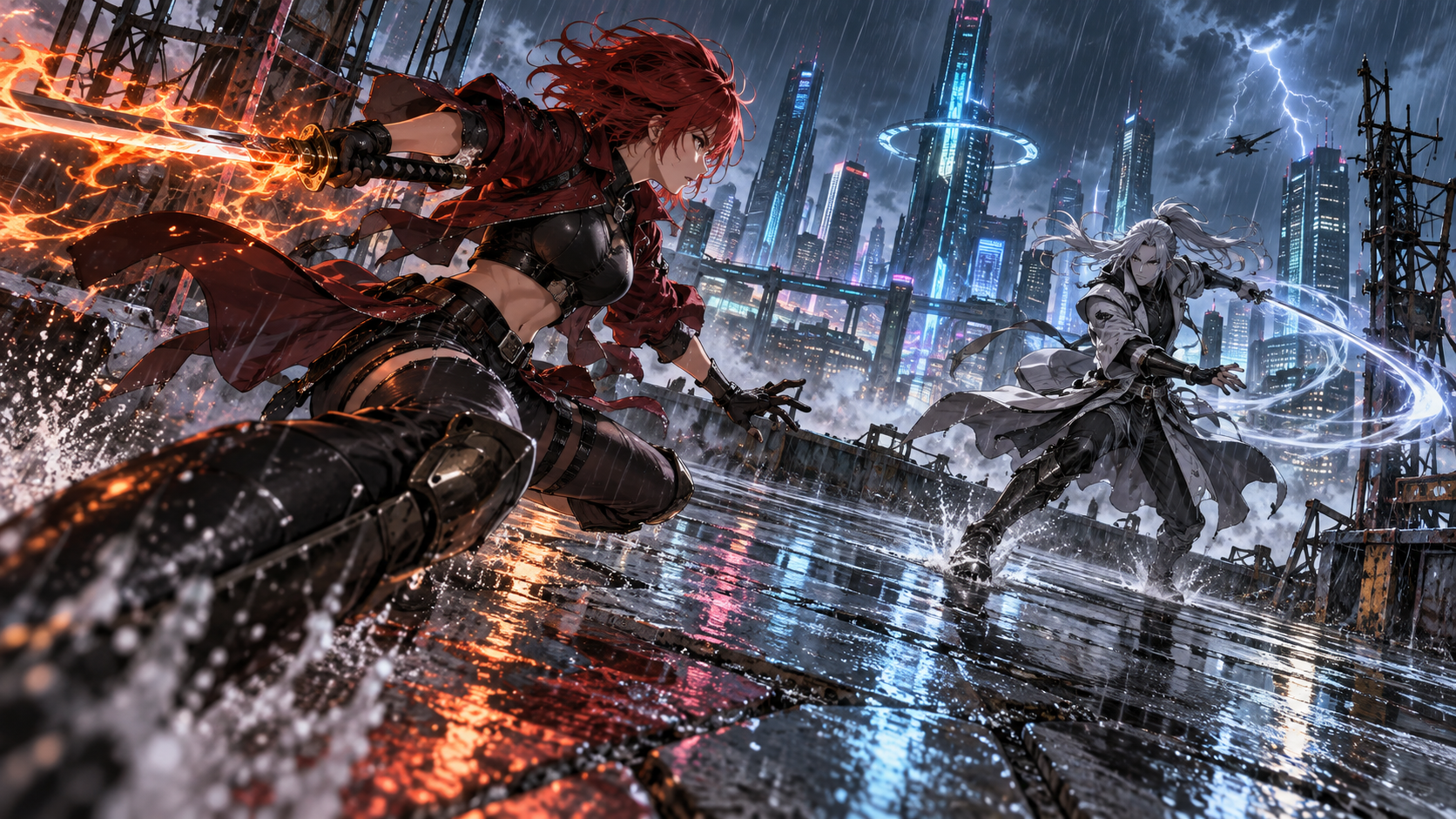
See how a non-graphic rooftop duel uses readable spacing, one controlled impact, environmental reactions, and a clear ending pose. This example contains no blood or injury.
This page pairs the existing Seedance 2.5 video task with an action-focused prompt and visual reference. It helps creators plan who moves, how the camera follows, where an impact happens, and how the shot resolves. If a story needs evidence of injury, keep it brief, stylized, and non-graphic; avoid exposed wounds, dismemberment, suffering, or gore.
A useful fight prompt treats choreography, camera direction, continuity, and harm limits as one connected shot plan.
Establish the fighters' starting positions, distance, direction of travel, obstacles, and safe landing areas.
Match tracking, orbiting, crane, or handheld motion to the action while keeping bodies and contact points readable.
Pair each attack with a defense or reaction, then let rain, dust, fabric, debris, or light reinforce the force of movement.
Repeat only the identity anchors that matter during motion: face, hair, costume, body build, weapon, and fighting style.
Assign a simple action to each time range and reserve the final moment for a stable, readable composition.
Prefer reaction, torn clothing, sparks, dust, or a brief stylized mark over realistic wounds, blood spray, or gore.
Turn an action idea into a reviewable clip with a compact four-step workflow.
Use references when identity and costume matter, a first frame for exact staging, or text for broader visual exploration.
Write a short sequence of approach, attack, defense, impact, and recovery. Keep the number of characters and major contacts limited.
Describe framing and motion, then state a clear non-graphic boundary such as no open wounds, blood spray, gore, or prolonged suffering.
Check anatomy, spatial continuity, weapon paths, contact, timing, and the final pose. Revise one weak beat at a time.
Apply the workflow where clear action storytelling matters and keep every concept within a non-graphic creative boundary.
Test blocking, screen direction, contact timing, and the end frame before committing to a longer production.
Plan original martial-arts, fantasy, superhero, or anime-inspired exchanges without copying protected characters.
Connect pursuit, obstacles, a brief confrontation, and escape in a compact sequence with clear spatial logic.
Compare low tracking, lateral movement, controlled handheld energy, or a final crane reveal around the same action.
Coordinate footsteps, cloth, weapon movement, impacts, ambience, and music without relying on graphic visuals.
When the story requires consequence, suggest it through performance, costume damage, or a restrained stylized mark rather than gore.
Answers about fight prompts, references, continuity, impact staging, and content-safety boundaries.
Define the adult characters, location, starting positions, action beats, camera path, environmental reactions, sound cues, final pose, and explicit limits on injury detail.
Choose text, first-frame, or reference-image generation; write a short causal action sequence; set the output options shown in the generator; then review and refine the weakest beat. Results can vary.
This page does not promise that any particular request will be accepted or produced. Keep any injury cue brief, restrained, and stylized, and avoid blood spray, exposed wounds, gore, dismemberment, or prolonged suffering.
Use clear references you have the right to use, make each silhouette and costume distinct, repeat key identity anchors, and avoid crowding the shot with extra characters or props.
Use anticipation, reaction, sound, sparks, dust, water spray, cloth movement, camera acceleration, and a brief timing change at contact.
Check faces, hands, body mechanics, spacing, screen direction, prop and weapon continuity, contact clarity, background stability, audio, and whether the harm stays within your intended boundary.
Bring a character reference and a compact action plan, then direct each movement, camera beat, and non-graphic impact.